
What Is ERP Therapy? How Exposure and Response Prevention Works for OCD
If you have looked into treatment for obsessive-compulsive disorder (OCD), you may have come across the term Exposure and Response Prevention, or ERP. ERP is a specialized form of Cognitive Behavioural Therapy (CBT) and is considered a first-line psychological treatment for OCD.
Despite its effectiveness, ERP can sound intimidating when it is first explained. The word “exposure” may bring to mind being forced to confront your biggest fear, while “response prevention” can sound like being expected to simply stop doing compulsions. In practice, good ERP treatment is much more collaborative and gradual than this.
ERP helps people change their relationship with anxiety, intrusive thoughts, and uncertainty by gradually approaching feared situations while reducing the compulsive behaviours that have been keeping the OCD cycle going.
Understanding the OCD cycle
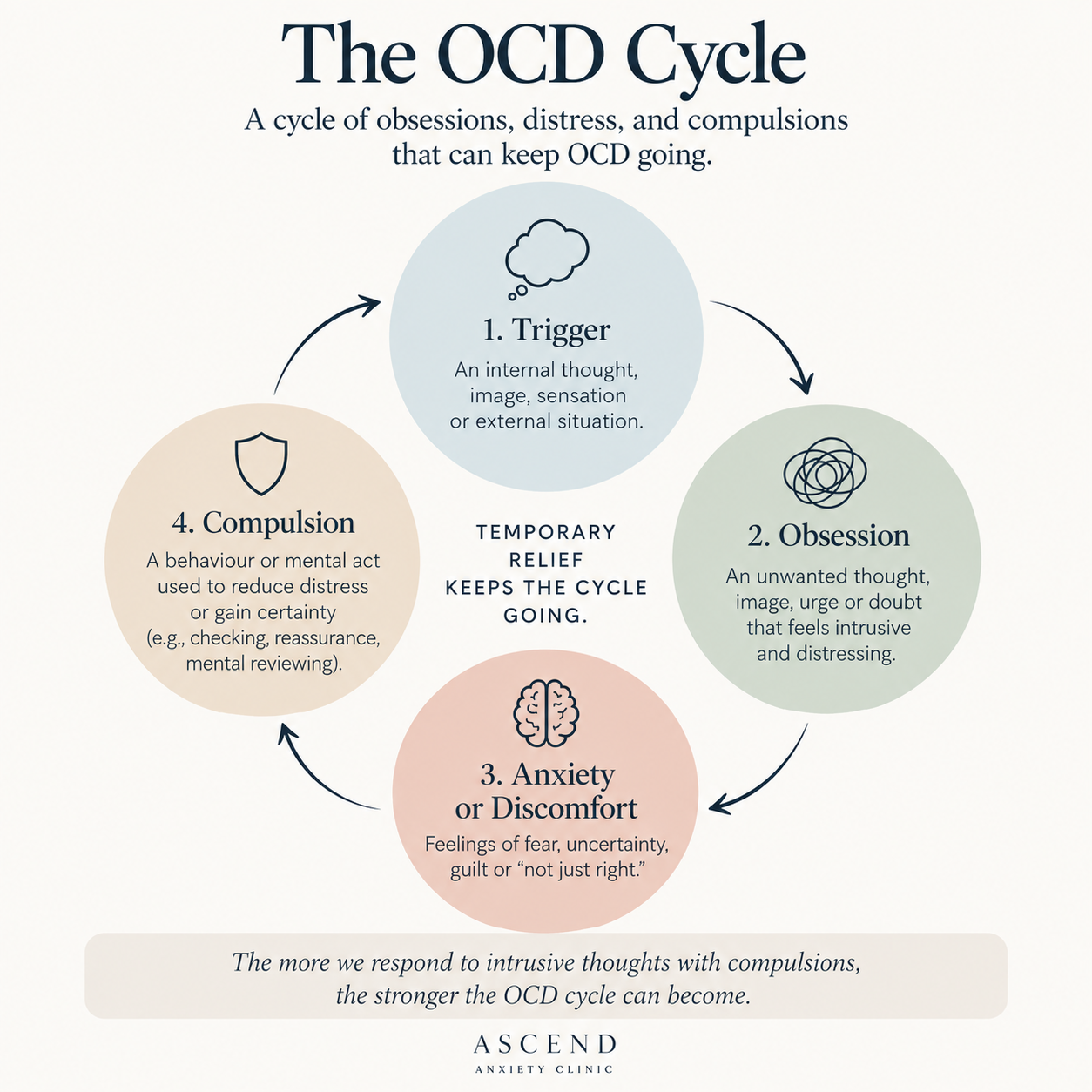
To understand how ERP works, it can be helpful to first understand what maintains OCD.
OCD involves obsessions, which are unwanted thoughts, images, urges, sensations, or doubts that create distress, and compulsions, which are behaviours or mental acts used to reduce that distress or gain certainty.
For example, someone may experience an intrusive thought that they accidentally harmed another person. In response, they might retrace their steps, review the event repeatedly in their mind, ask someone for reassurance, search online for information, or try to convince themselves that they would never hurt anyone.
These compulsions can provide temporary relief. The problem is that the relief teaches the brain that the intrusive thought was important enough to require a response.
Over time, this can create a cycle:
Trigger → Obsession → Anxiety or discomfort → Compulsion → Temporary relief → OCD becomes reinforced
ERP aims to interrupt this cycle.
What does “exposure” mean in ERP?
The exposure component of ERP involves intentionally approaching situations, thoughts, images, sensations, or uncertainty that trigger OCD rather than automatically avoiding them.
Importantly, exposure is not about frightening someone for the sake of making them anxious. Exposures are chosen collaboratively and are designed around the individual's specific OCD symptoms and treatment goals.
For someone with contamination OCD, an exposure might involve touching something they perceive as contaminated. For someone with relationship OCD, it might involve allowing uncertainty about whether their relationship is “right” without trying to resolve the question. Someone with harm OCD might practise allowing an intrusive thought to be present without trying to prove that it could never happen.
Exposure can also involve thoughts rather than physical situations. Imaginal exposure, for example, can be used to practise approaching feared possibilities that cannot easily or appropriately be recreated in real life.
The specific exercise matters less than the broader goal: learning that you can experience uncertainty and discomfort without needing to immediately escape from them or make them go away.
What is “response prevention”?
Exposure is only one part of ERP. The second component, response prevention, is equally important.
Response prevention means practising a different response to the urge to perform a compulsion.
If someone usually responds to an intrusive thought by asking for reassurance, response prevention might involve allowing the question to remain unanswered. If they repeatedly check whether a door is locked, it might involve leaving after checking once rather than returning to check again. If they mentally review a conversation until they feel certain they did not offend someone, response prevention may involve noticing the urge to review without engaging in the analysis.
This can initially feel uncomfortable because compulsions often provide immediate relief. However, repeatedly choosing not to engage in the compulsion creates opportunities for new learning.
Rather than teaching yourself, “I can only handle this feeling if I get certainty,” you begin learning, “I can experience uncertainty without having to resolve it.”
Does ERP mean starting with your biggest fear?
One common misconception about ERP is that therapy involves immediately confronting the most frightening item on your list.
ERP is typically much more gradual and collaborative.
Early in treatment, you and your therapist will identify the situations, thoughts, sensations, and uncertainties that trigger your OCD. These can then be organized into an exposure hierarchy, which helps you understand which situations feel relatively manageable and which feel significantly more difficult.
Treatment often begins with exposures that are challenging enough to provide meaningful practice without immediately jumping to the most difficult situation imaginable. As you become more comfortable practising exposure and response prevention, you can gradually work toward more challenging areas of the hierarchy.
The goal is not to surprise you, trick you, or force you into an exposure. Effective ERP involves understanding why an exercise is being used and working collaboratively toward goals that matter to you.
Is the goal of ERP to make anxiety disappear?
It is understandable to assume that successful ERP means eventually completing an exposure without feeling anxious.
However, eliminating anxiety is not necessarily the goal.
If every exposure becomes an attempt to make anxiety disappear, anxiety itself can become something that needs to be controlled. Instead, ERP helps build greater flexibility around uncomfortable internal experiences.
You may still experience an intrusive thought. You may still notice anxiety. You may still have moments when you desperately want certainty.
What can change is what happens next.
With practice, an intrusive thought does not have to turn into an hour of rumination. A feeling of uncertainty does not have to lead to reassurance-seeking. Anxiety does not have to determine whether you participate in something that matters to you.
Over time, this can reduce the amount of attention, time, and energy that OCD takes from your life.
What kinds of OCD can ERP treat?
ERP can be used across many different OCD presentations. This can include contamination OCD, checking OCD, harm OCD, relationship OCD (ROCD), health-related OCD, religious or moral scrupulosity, sexual intrusive thoughts, responsibility fears, and other forms of OCD.
ERP is not determined by the specific content of an intrusive thought. Although OCD themes can look very different from one another, the underlying cycle of obsession, distress, and compulsive responding is often similar.
Treatment therefore focuses not only on what you are afraid of, but also on how you have learned to respond when uncertainty or intrusive thoughts appear.
What does ERP therapy actually look like?
ERP usually involves more than completing exposures during a therapy session.
Early sessions often focus on understanding your symptoms, identifying obsessions and compulsions, learning how the OCD cycle works, and developing an individualized treatment plan. From there, you and your therapist can build an exposure hierarchy and begin practising ERP both during sessions and between appointments.
As treatment progresses, the focus increasingly shifts toward applying these skills in everyday life. This is important because OCD rarely appears only during a therapy appointment. Learning to recognize compulsions and practise responding differently when OCD shows up outside of therapy is an important part of creating lasting change.
ERP can also be integrated with approaches such as Acceptance and Commitment Therapy (ACT), which can help people practise making choices based on their values rather than allowing anxiety and uncertainty to dictate their behaviour.
ERP therapy for OCD in Ontario
Living with OCD can be exhausting, particularly when intrusive thoughts and compulsions begin taking up significant amounts of time or interfering with relationships, school, work, or everyday life. Effective treatment does not require you to prove that your fears are impossible or achieve complete certainty about your intrusive thoughts.
Instead, ERP can help you learn that uncertainty can be present without requiring a compulsion and that OCD does not have to determine how you live your life.
At Ascend Anxiety Clinic, we provide specialized therapy for OCD and anxiety-related concerns using evidence-based approaches including Exposure and Response Prevention (ERP), Cognitive Behavioural Therapy (CBT), and Acceptance and Commitment Therapy (ACT).
We offer in-person OCD therapy in Burlington and virtual OCD therapy across Ontario, including support for adults and teens experiencing intrusive thoughts, compulsions, relationship OCD, contamination fears, harm OCD, health-related fears, and other OCD presentations.
If you are looking for OCD treatment or wondering whether ERP may be appropriate for you, book a free 15-minute consultation with Ascend Anxiety Clinic to learn more about treatment and determine whether one of our therapists may be a good fit.