
What Does It Actually Mean to “Sit With” Your Emotions?
“Sit with the feeling” is a phrase that comes up often in therapy. It can also be frustrating advice when no one explains what it actually means. Are you supposed to focus on the emotion? Wait for it to pass? Try to understand where it came from? And what if paying attention to it only seems to make it stronger?
Sitting with an emotion does not mean dwelling on it or waiting until you feel better. It generally means allowing an uncomfortable internal experience to be present without immediately trying to change it, escape it, or figure it out. This can be particularly difficult for people who struggle with anxiety, OCD, overthinking, or a strong need for certainty, because discomfort often creates an equally strong urge to do something about it.
Why do we try so hard to get rid of uncomfortable emotions?
Most people naturally prefer feeling calm, happy, and certain over feeling anxious, guilty, sad, or uncomfortable. When distress shows up, our brains tend to look for ways to reduce it.
Sometimes this is helpful. If we are upset because of a problem that can realistically be addressed, taking action may be exactly what we need. The difficulty arises when we begin treating every uncomfortable internal experience as a problem that requires an immediate solution.
For someone with social anxiety, this might involve replaying a conversation to determine whether they said something embarrassing. Someone experiencing health anxiety might repeatedly check a bodily sensation or search symptoms online. A person struggling with OCD might seek reassurance or mentally review a situation until they feel more certain. Someone who feels guilty after setting a boundary might immediately apologize or change the boundary to relieve the guilt.
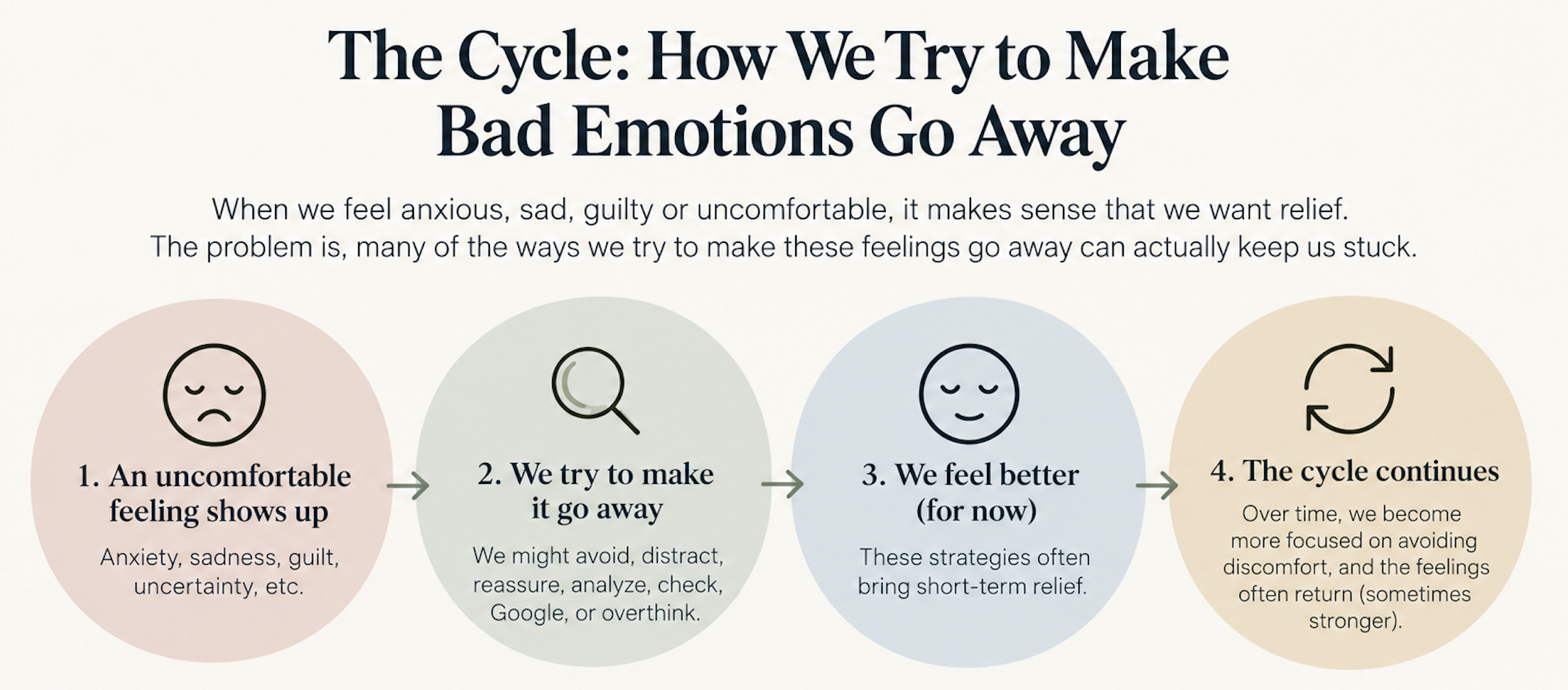
Although these responses look different, they often serve a similar purpose: reducing discomfort. When checking, avoiding, analyzing, or seeking reassurance makes us feel better, even temporarily, we are more likely to use the same strategy the next time discomfort appears. Over time, this can reinforce the idea that uncomfortable feelings are something we need to control before we can move forward.
What does it mean to sit with a feeling?
Sitting with a feeling means making room for the experience without immediately responding to the urge to get rid of it.
Imagine feeling anxious before entering a social event. Sitting with the anxiety does not mean standing outside and focusing on how anxious you feel until it decreases. It may simply mean recognizing that you are anxious and entering the event without first needing to make yourself feel calm.
Similarly, if you experience guilt after setting a reasonable boundary, sitting with the feeling might involve allowing the guilt to remain without immediately taking back the boundary or asking someone else to confirm that you did the right thing.
In both situations, the goal is not to enjoy the emotion or pretend that it is comfortable. The goal is to become less dependent on changing the emotion before deciding what to do next.
Sitting with an emotion is different from analyzing it
For people who tend to overthink, this distinction can be particularly important.
We can spend a significant amount of time thinking about an emotion without necessarily allowing ourselves to experience it. Anxiety may quickly lead to questions such as: Why am I feeling this way? What triggered this? Does this feeling mean something? What if I still feel like this tomorrow? How do I know whether I made the right decision?
Reflection can be useful, and understanding our emotional patterns is often an important part of therapy. However, reflection becomes less helpful when we feel unable to move forward until we have completely understood or resolved what we are feeling.
Sometimes there may not be a clear answer. At other times, finding an answer provides only temporary relief before another question appears. Part of sitting with an emotion can therefore involve tolerating the fact that we may not completely understand why we feel the way we do.
What about physical sensations?
Emotions are not experienced only through thoughts. Anxiety in particular can involve noticeable physical sensations, including changes in heart rate, muscle tension, nausea, dizziness, warmth, pressure, or changes in breathing.
Trying not to notice these sensations can easily become another form of monitoring. Someone who is repeatedly checking whether they can still feel their heartbeat is, understandably, going to remain very aware of their heartbeat.
A useful distinction is between noticing a sensation and investigating it.
Noticing that your chest feels tight is an observation. Repeatedly checking whether the tightness has changed, comparing it with how you felt yesterday, testing the sensation, or trying to determine exactly what it means moves into investigation.
We cannot always control which sensations capture our attention. What we can work on is how we respond once we notice them.
This is especially relevant in health anxiety, where normal or ambiguous bodily sensations can quickly lead to checking, researching, reassurance-seeking, and attempts to determine whether something is wrong. Treatment is not about learning to ignore your body. Instead, part of the work may involve becoming more able to notice sensations without automatically entering a cycle of monitoring and interpretation.
Sitting with emotions does not mean doing nothing
The phrase “sit with it” can give the impression that we are supposed to stop what we are doing and focus entirely on the emotion. In practice, sitting with an emotion often involves continuing with our lives while allowing the emotion to come with us.
If you feel anxious before meeting friends, you can still go. If uncertainty shows up after making a decision, you can continue with your day without repeatedly reconsidering it. If an intrusive thought appears, you can allow the thought to be present without stopping to determine what it means.
This is different from distraction. Distraction is typically aimed at getting away from an internal experience: I need to do something so I stop feeling this. Sitting with an emotion involves allowing the experience to remain present while choosing where you want to direct your attention and behaviour.
This idea is central to approaches such as Acceptance and Commitment Therapy (ACT), which emphasizes making room for difficult internal experiences while continuing to engage in actions that are consistent with what matters to us.
How can you practice sitting with an emotion?
When an uncomfortable feeling appears, begin by noticing what is happening without immediately trying to change it. This can be as simple as recognizing, “I'm feeling anxious right now.”
Next, notice what you feel pulled to do in response. Do you want to avoid something, ask for reassurance, check, analyze the situation, search for information, replay an interaction, or keep thinking until you reach an answer that feels certain?
Rather than immediately following that urge, consider whether something genuinely needs to be addressed or whether the response is primarily an attempt to make the discomfort go away. If it is the latter, experiment with allowing the feeling to remain unresolved for a while.
From there, ask yourself: “What would I want to be doing right now if I didn't need to get rid of this feeling first?”
Then continue in that direction, even if some discomfort comes with you.
This does not mean that emotions should always be ignored or that every uncomfortable situation needs to be tolerated. Emotions can provide important information about our needs, relationships, boundaries, and circumstances. The goal is to create enough space between the feeling and our response that we can decide what is actually helpful rather than automatically reacting in whatever way provides the quickest relief.
Most importantly, sitting with an emotion is not successful only when the emotion decreases. Sometimes it will, and sometimes it will remain for a while. If we measure success by how quickly we feel better, acceptance can easily become another strategy for trying to control how we feel.
Learning to respond differently to discomfort
Learning to sit with difficult emotions takes practice, particularly if you are used to responding to discomfort through avoidance, reassurance, checking, or overthinking. These patterns often develop precisely because they work in the short term: they provide relief, certainty, or a sense of control.
The goal is not to reach a point where anxiety, sadness, guilt, uncertainty, or intrusive thoughts no longer bother you. Instead, the goal is to have more choice in how you respond when they appear.
Over time, difficult emotions can become experiences that you are able to have rather than problems that always need to be solved.
Looking for support with anxiety or overthinking?
If anxiety, intrusive thoughts, reassurance-seeking, overthinking, or difficulty tolerating uncertainty are interfering with your day-to-day life, therapy can help you better understand the patterns that are keeping you stuck and develop different ways of responding to them.
At Ascend Anxiety Clinic, we provide evidence-based therapy for anxiety and OCD using approaches including Cognitive Behavioural Therapy (CBT), Exposure and Response Prevention (ERP), and Acceptance and Commitment Therapy (ACT). We offer in-person therapy in Burlington and virtual therapy across Ontario.
Book a free 15-minute consultation to learn more about working with one of our therapists.