
Why Am I so Afraid of Throwing up? Understanding Emetophobia
For some people, the thought of vomiting is unpleasant. For others, it can trigger intense fear, anxiety, or an overwhelming need to prevent it from happening.
This intense fear of vomiting is known as emetophobia. It can affect much more than how someone feels about being sick. Over time, people may begin changing what they eat, where they go, how they travel, who they spend time with, or how closely they monitor their body for signs of nausea.
Emetophobia is treatable. With appropriate treatment, it is possible to spend less time trying to prevent or prepare for vomiting and more time making decisions based on the life you actually want to live.

What Is Emetophobia?
Emetophobia is an intense and persistent fear of vomiting or being around vomit. For some people, the fear is focused primarily on vomiting themselves. For others, the fear may involve seeing someone else vomit, feeling nauseous, losing control, becoming sick in public, or being unable to escape a situation where vomiting could occur.
The fear can range from mild worry to significant anxiety and panic.
It may also become connected to other fears, such as concerns about contamination, illness, embarrassment, or not being able to cope if something goes wrong.
What Does Emetophobia Look Like?
Emetophobia does not look exactly the same for everyone.
Someone experiencing emetophobia might:
• Avoid foods they associate with illness or food poisoning
• Avoid restaurants, buffets, or unfamiliar foods
• Feel anxious about eating before leaving home
• Avoid alcohol or foods they believe could cause nausea
• Frequently check food expiration dates or inspect food for signs that it is unsafe
• Repeatedly seek reassurance that they will not become sick
• Avoid people who are sick or have recently been sick
• Feel anxious about being in crowded spaces, on airplanes, public transit, or other places where leaving may feel difficult
• Avoid travel or overnight stays away from home
• Monitor their body closely for sensations such as nausea or stomach discomfort
• Avoid situations where they believe vomiting would be embarrassing
• Experience panic when they feel nauseous
• Spend significant amounts of time thinking about whether they might become sick
Sometimes, the avoidance can become so extensive that a person does not realize how much their fear is influencing their choices.
Why Does Emetophobia Become So Powerful?
One of the most difficult parts of emetophobia is that avoidance can provide immediate relief while making anxiety stronger over time.
For example, imagine someone feels anxious about eating at a restaurant because they are afraid they might become sick. They decide not to go. Their anxiety decreases.
The brain can then learn:
“Not going to the restaurant kept me safe.”
The next time a similar situation comes up, the fear may feel even more convincing.
The same cycle can happen with reassurance, checking, carrying “just in case” items, avoiding certain foods, or constantly monitoring the body for signs of nausea.
These behaviours are understandable attempts to manage anxiety. However, over time, they can reinforce the belief that the feared situation is dangerous or that the person would be unable to cope without these precautions.
What About Nausea?
For people with emetophobia, physical sensations can become particularly frightening.
Anxiety itself can cause changes in the digestive system, muscle tension, dizziness, a racing heart, and sensations in the stomach. These sensations may then be interpreted as signs that vomiting is about to happen.
This can create a cycle:
Anxiety → physical sensations → “I might be sick” → increased fear → more physical sensations.
The person may then become hyperaware of every sensation in their stomach, which can make ordinary bodily sensations feel much more threatening.
Learning to respond differently to these sensations can be an important part of treatment.
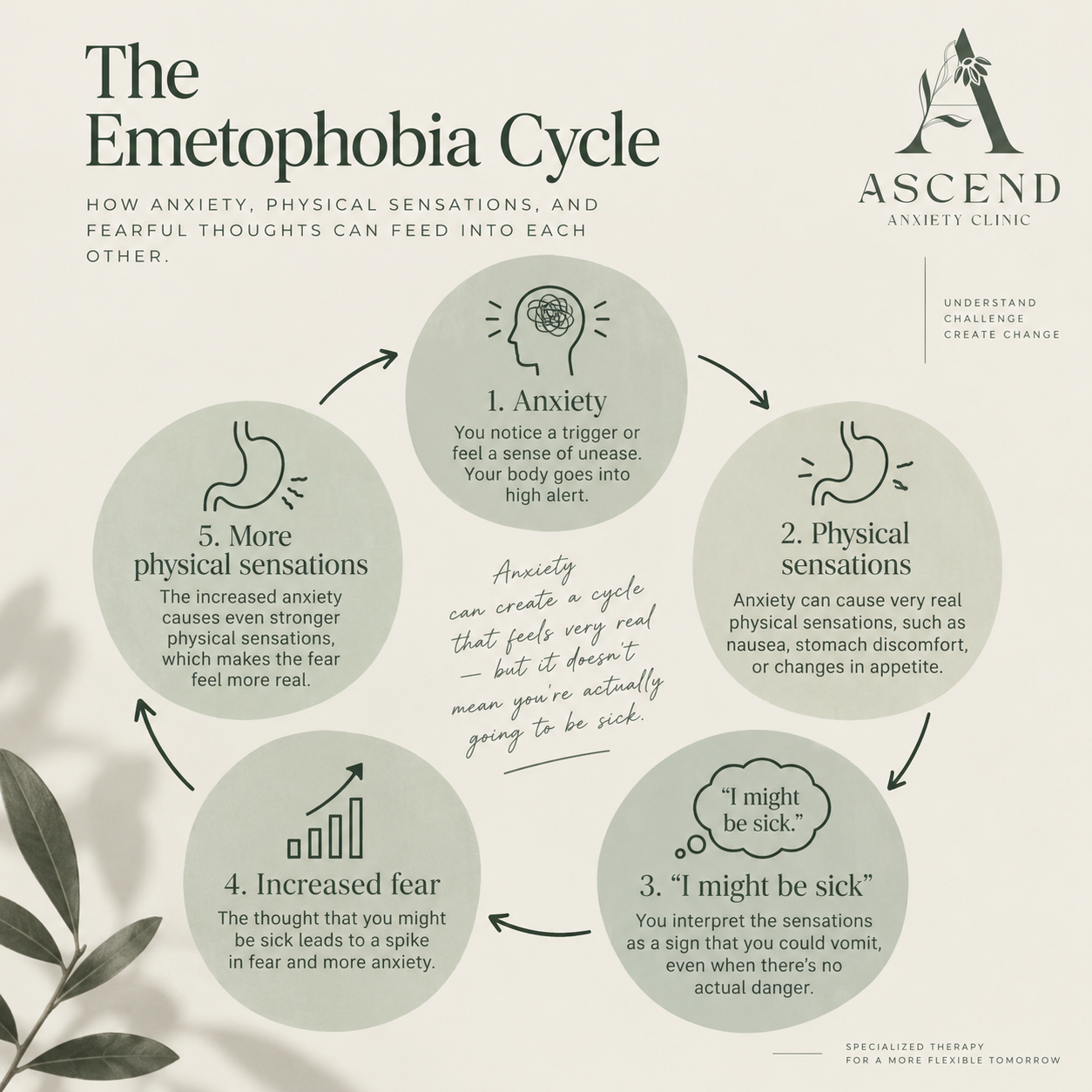
The Emetophobia Cycle
Anxiety can create physical sensations that are interpreted as signs of illness, increasing fear and intensifying those sensations further.
Emetophobia and Everyday Life
Emetophobia can gradually become more restrictive.
A person might initially avoid one particular situation, such as eating a specific food. Over time, the list of things they avoid may grow.
They may stop going out for meals, decline invitations, avoid travel, limit their diet, or feel uncomfortable when they cannot control their surroundings.
This can be especially difficult because other people may not understand why something that seems “small” to them creates such intense anxiety.
Emetophobia is not a choice or an overreaction that someone can simply think their way out of. The fear is real, and the anxiety response can be very strong.
How Is Emetophobia Treated?
Therapy for emetophobia often focuses on helping people change their relationship with fear rather than trying to guarantee that they will never feel nauseous or never vomit.
Cognitive behavioural therapy (CBT) is commonly used to treat phobias and anxiety. Treatment may involve identifying anxious predictions, understanding avoidance and safety behaviours, and gradually approaching feared situations.
Exposure-and Response Prevention is also an important component of treatment. Exposure is carefully and collaboratively planned based on the individual's fears and treatment goals. The purpose is not to overwhelm someone or force them into situations before they are ready. Instead, it provides opportunities to learn that anxiety and uncertainty can be tolerated and that feared outcomes may be less catastrophic than they feel.
Treatment addresses:
• Reassurance seeking
• Checking and monitoring
• Avoidance and safety behaviours
• Fear of physical sensations
• Intolerance of uncertainty
• Anxiety about losing control
• Fear of embarrassment
• Restrictive eating patterns related to fear of vomiting
The goal is not necessarily to make the possibility of vomiting feel pleasant. Rather, treatment can help you develop greater confidence in your ability to cope with uncertainty, anxiety, and uncomfortable sensations.
What Might an Exposure Hierarchy Look Like?
Exposure therapy for emetophobia is typically gradual and tailored to the individual's specific fears. A therapist may work with you to create a hierarchy that starts with situations that feel challenging but manageable and gradually progresses toward more difficult situations.
For example, an illustrative five-step hierarchy might look like:
1. Reading the word “vomit” or “vomiting” — noticing the thoughts and feelings that arise without immediately avoiding or seeking reassurance.
2. Looking at a cartoon or mild, non-graphic image related to vomiting — staying with the discomfort until it becomes more manageable.
3. Watching a brief, non-graphic video depicting someone feeling nauseous or becoming sick — allowing anxiety to rise and fall without using usual safety behaviours.
4. Eating a previously avoided food at home — practicing tolerance of uncertainty about whether the food could cause nausea or illness.
5. Eating at a restaurant or travelling somewhere where leaving quickly may feel difficult — applying these skills in a situation that more closely resembles the person's real-life fears.
The actual hierarchy would look different for each person. Someone might need several steps between these examples, while another person may have completely different triggers.
The goal of exposure is not to prove that nothing bad will happen. Instead, it is to build confidence in your ability to experience uncertainty, anxiety, and uncomfortable sensations without allowing fear to dictate your choices.
Exposure work should be collaborative and appropriately paced. A therapist can help determine which situations to work on, how to approach them, and how to reduce behaviours that may unintentionally keep the fear going.
You Don't Have to Let Fear Make Your Decisions
If fear of vomiting is influencing what you eat, where you go, who you spend time with, or what you feel able to do, therapy can help.
At Ascend Anxiety Clinic, we provide specialized therapy for emetophobia, anxiety, and OCD using evidence-based approaches including CBT and ERP. Treatment is individualized to your specific fears and focuses on helping you reduce avoidance, respond differently to anxiety, and build greater confidence in your ability to cope with uncertainty.
We offer in-person therapy in Burlington and virtual therapy across Ontario, with free 15-minute consultations available if you would like to learn more about treatment.
You do not need to wait until your world becomes very small before reaching out for help.