
Emetophobia vs. OCD: When the Fear of Throwing Up Becomes an Obsession
For someone with a fear of throwing up, everyday situations can involve a surprising amount of mental effort. Eating at a restaurant might mean carefully reviewing the menu for foods that feel safe. Hearing that a coworker has a stomach bug might lead to days of worrying about whether you've been exposed. Even a slight change in how your stomach feels can trigger a series of anxious thoughts about whether you're about to get sick.
These experiences are commonly associated with emetophobia, an intense fear of vomiting. However, some people also notice that their fear involves repetitive thoughts, checking behaviours, or an overwhelming need for reassurance. This can raise an important question: is it emetophobia, obsessive-compulsive disorder (OCD), or a combination of both?
Although these conditions can look similar in everyday life, understanding the differences can help clarify what's maintaining the anxiety and which treatment approaches may be most helpful.
What Is Emetophobia?
Emetophobia is a specific phobia involving an intense fear of vomiting. For some people, the fear centres on throwing up themselves, while others are particularly afraid of witnessing someone else vomit. Many experience both.
Like other specific phobias, emetophobia often leads to avoidance of situations associated with the feared experience. Someone might avoid certain foods, restaurants, public transportation, alcohol, or social gatherings because of the possibility of becoming sick.
Emetophobia can also involve heightened awareness of physical sensations. People may become particularly sensitive to nausea, fullness, indigestion, or other normal changes in how their stomach feels. These sensations can quickly become associated with the possibility of vomiting, even when there is no clear indication that they are about to be sick.
Over time, attempts to prevent vomiting can become increasingly restrictive. What begins as avoiding one particular food or situation may gradually expand into a much larger set of rules about what feels safe.
How Is OCD Different From Emetophobia?
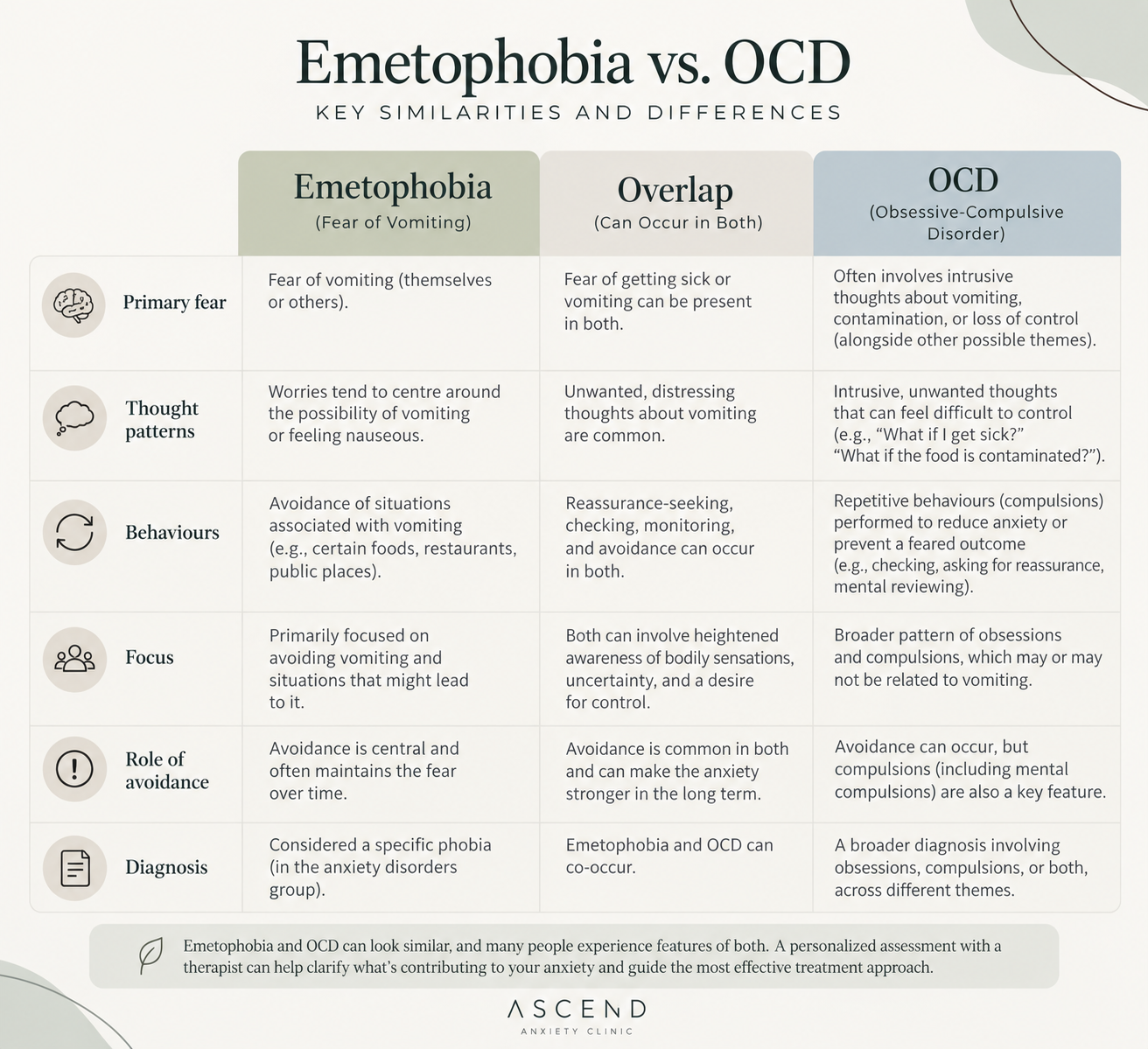
Obsessive-compulsive disorder involves two primary components: obsessions and compulsions.
Obsessions are unwanted, intrusive thoughts, images, or urges that create distress. Compulsions are repetitive behaviours or mental acts performed in response to obsessions, often in an attempt to reduce anxiety, prevent something feared from happening, or achieve a sense of certainty.
For someone with OCD, the fear of vomiting might become the focus of persistent intrusive thoughts, such as worrying that food has been contaminated, that they have unknowingly contracted a stomach virus, or that they might suddenly become sick in public.
In response, they may engage in compulsions intended to reduce the perceived risk. These might include repeatedly checking expiration dates, washing their hands according to rigid rules, asking others whether food is safe, or mentally reviewing everything they've eaten.
Although these behaviours may temporarily reduce anxiety, the relief often doesn't last. Doubt returns, and the person feels compelled to check, review, or seek reassurance again.
One important distinction is that repetitive checking or reassurance-seeking does not automatically mean someone has OCD. People with specific phobias can also engage in safety behaviours that appear compulsive. Clinicians consider the broader pattern of symptoms, the function of these behaviours, and whether the person meets the diagnostic criteria for either condition.
Where Emetophobia and OCD Overlap
The overlap between emetophobia and OCD can make it difficult to distinguish between the two, particularly when the feared outcome is the same.
Consider someone who is afraid of getting food poisoning. Before eating, they carefully inspect their food, check expiration dates, and ask someone else whether it looks safe. After eating, they monitor their stomach for signs of nausea and mentally review whether anything tasted unusual.
These behaviours could occur in someone with emetophobia, OCD, or both. The distinction often depends on the broader clinical picture, including how the thoughts and behaviours function.
For someone with emetophobia, avoidance and safety behaviours may primarily serve to reduce contact with situations associated with vomiting. In OCD, repetitive behaviours may also be driven by intrusive doubts, rigid rules, or a perceived need to neutralize a feared possibility.
However, these patterns are not exclusive to either condition, and the presence of one does not rule out the other.
1. Reassurance-Seeking
Someone who fears vomiting might frequently ask questions such as, "Do you think this food is okay?" or "Does this sound like a stomach bug?"
Reassurance can provide immediate relief, but that relief is often temporary. When another uncomfortable sensation or uncertain situation arises, the person may feel the need to ask again.
In OCD, reassurance-seeking can function as a compulsion. In emetophobia, it may also serve as a safety behaviour that maintains the fear. In both cases, repeatedly seeking certainty can make it more difficult to tolerate uncertainty over time.
2. Checking and Monitoring
Checking behaviours are another common area of overlap. Someone might repeatedly examine food, check whether others are showing signs of illness, or monitor their own body for nausea.
Body scanning can become particularly exhausting because the digestive system naturally produces a wide range of sensations throughout the day. When someone is constantly monitoring these sensations, even minor changes can begin to feel significant.
The resulting anxiety can also contribute to gastrointestinal discomfort, creating a cycle in which the person becomes increasingly concerned about the very sensations their anxiety may be intensifying.
3. Mental Reviewing and Rumination
Not all repetitive behaviours are visible.
Someone might spend considerable time mentally reviewing what they ate, whether they washed their hands thoroughly enough, or whether a person they encountered appeared unwell.
They may replay conversations, research symptoms, or try to determine the exact likelihood of becoming sick.
Although this can feel like problem-solving, the process may become repetitive and unproductive. Rather than reaching a lasting conclusion, the person often finds themselves returning to the same questions.
In OCD, mental reviewing can function as a compulsion when it is performed to neutralize intrusive doubts or obtain certainty. Similar patterns of rumination can also occur in people with emetophobia who do not have OCD.
4. Avoidance
Avoidance is central to many phobias, including emetophobia, but it can also occur in OCD.
Someone might stop eating at restaurants, avoid travelling, or decline invitations to social events because they fear vomiting or being around someone who becomes sick.
While avoiding these situations can provide short-term relief, it also limits opportunities to learn that uncertainty and anxiety can be tolerated without relying on avoidance.
As a result, the person's world may gradually become smaller, even when they recognize that their fear is interfering with things they value.
Can You Have Both Emetophobia and OCD?
Yes. It is possible to experience both emetophobia and OCD, and the two conditions can interact in ways that reinforce one another.
For example, someone may have a longstanding fear of vomiting that leads them to avoid restaurants and unfamiliar foods. They may also experience intrusive contamination-related obsessions and feel compelled to follow rigid cleaning or checking rituals to prevent illness.
In this situation, the person may meet criteria for both conditions, although a thorough clinical assessment would be needed to determine whether separate diagnoses are appropriate.
It's also worth remembering that OCD is not defined by how frequently someone thinks about a particular fear. A person can experience intense, persistent anxiety about vomiting without necessarily having OCD.
The nature of the intrusive thoughts, the role of compulsions, and the overall pattern of symptoms are important considerations when distinguishing between the two.
Why Does the Distinction Matter?
If emetophobia and OCD share so many features, you might wonder whether it matters which condition you're experiencing.
The distinction can be helpful because it allows treatment to address the specific processes maintaining the fear.
For someone whose primary difficulty is emetophobia, treatment may focus on gradually approaching situations associated with vomiting, reducing avoidance, and developing greater tolerance for uncomfortable physical sensations and uncertainty.
For someone experiencing OCD, treatment may also need to directly address compulsions, including those that happen internally, such as mental reviewing, reassurance-seeking, or attempts to neutralize intrusive thoughts.
When both conditions are present, treatment can be tailored to address their overlapping features while accounting for the individual's particular symptoms.
How Are Emetophobia and OCD Treated?
One of the most well-established psychological treatments for OCD is Exposure and Response Prevention (ERP), a form of Cognitive Behavioural Therapy (CBT). Exposure-based CBT is also an evidence-based treatment for specific phobias, including emetophobia.
ERP involves gradually approaching feared situations, thoughts, or sensations while reducing the behaviours that typically provide immediate relief from anxiety.
For someone with a fear of vomiting, this might involve reading or discussing vomiting-related scenarios, gradually returning to avoided activities, or practicing eating without excessive checking or reassurance-seeking.
For someone whose fear is also associated with OCD, treatment may place additional emphasis on resisting compulsive responses, including mental rituals that are not immediately obvious to others.
Exposure work should be individualized, collaborative, and appropriately paced. It does not require someone to intentionally make themselves vomit, and the goal is not to expose someone to unnecessary medical risks.
Acceptance and Commitment Therapy (ACT) may also be incorporated to help individuals develop a different relationship with anxious thoughts and uncomfortable sensations. Rather than organizing daily life around eliminating every possibility of vomiting, treatment can support people in making decisions based on their values and what matters to them.
Ultimately, the goal is not to guarantee that vomiting will never happen. It is to reduce the extent to which fear, avoidance, and compulsive behaviours interfere with everyday life.
Finding Support for Emetophobia and OCD
If you spend a significant amount of time worrying about vomiting, checking your body for symptoms, or trying to prevent situations where you might become sick, it can be difficult to know where the fear ends and the repetitive anxiety begins.
You don't need to determine whether your experiences are better explained by emetophobia or OCD before reaching out for support. A therapist familiar with both conditions can help you understand the patterns contributing to your anxiety and develop a treatment approach that reflects your individual needs.
At Ascend Anxiety Clinic, we specialize in supporting individuals experiencing OCD, emetophobia, and other anxiety-related concerns. Our therapists use evidence-based approaches, including CBT, ERP, and ACT, to help clients reduce avoidance, respond differently to intrusive thoughts, and develop greater confidence in navigating uncertainty.
We offer in-person therapy in Burlington, Ontario, and virtual therapy across Ontario.
If fear of vomiting has started to influence your decisions, relationships, or daily routines, we're here to help you explore what moving forward could look like.
Book a free 15-minute consultation with Ascend Anxiety Clinic to learn more about our approach to emetophobia and OCD treatment.